


Radiotherapy is – alongside surgery and chemotherapy – one of the three main methods of cancer treatment. Since 2022 I have been the Medical Director of the RTWet centre – the first and only megavoltage veterinary radiotherapy centre in Poland and in Central and Eastern Europe. We treat patients here from all over Poland and from neighbouring countries.
What is megavoltage radiotherapy?
Radiotherapy uses ionising radiation produced by a linear accelerator. The radiation damages the DNA of cancer cells and stops them from dividing. The treatment plan is prepared individually on the basis of a computed tomography (CT) scan, so that the dose reaches the tumour precisely while the surrounding healthy tissue is spared as far as possible.
When is radiotherapy used?
- Brain tumours (including gliomas and meningiomas) – in many cases radiotherapy is the treatment of choice. I discussed this topic at the 14th Radiology and Surgery Conference.
- Nasal cavity tumours and tumours in other areas that are difficult to reach surgically.
- Oral cavity tumours, e.g. melanoma or squamous cell carcinoma.
- After incomplete removal of a tumour – e.g. soft tissue sarcomas or mast cell tumours – to destroy the remaining cancer cells and reduce the risk of recurrence.
- Lymphoma in dogs – half-body irradiation (HBI) combined with chemotherapy; since 2025 we have used this method at the RTWet centre as the first in Poland.
- Palliative treatment – e.g. reducing pain in bone tumours.
Radiotherapy was, among other things, part of the treatment of Borys, who had recurrent squamous cell carcinoma of the digits.
Half-body irradiation (HBI) in the treatment of lymphoma in dogs
Since 2025, as the first in Poland, we have introduced half-body irradiation (HBI) at the RTWet centre for the treatment of lymphoma in dogs.
Lymphoma in dogs remains a major challenge: standard multi-agent chemotherapy achieves remission in most patients, but the median survival is around 12 months. Cancerous lymphocytes are very sensitive to radiation – especially in B-cell lymphomas – so radiotherapy can effectively complement chemotherapy and destroy cells that have survived treatment.
What does HBI treatment involve?
- Chemotherapy first. The key to success is achieving complete clinical remission with chemotherapy before irradiation begins.
- Irradiation of each half of the body in turn. The dog’s body is divided into a front and a rear half, which are irradiated sequentially – with an interval that allows the bone marrow to recover.
- Good tolerance. HBI given sequentially in combination with chemotherapy is well tolerated by patients.
What results does it give?
According to published data, combining chemotherapy with HBI can extend the median survival of dogs with lymphoma to more than 700 days – compared with about 12 months after chemotherapy alone. A more intensive method is total body irradiation (TBI), used as part of preparation for stem cell transplantation; however, it is associated with high costs and requires specialist care.
I described both methods in detail in the article “Radiotherapy in the treatment of lymphoma in dogs – TBI and HBI” (Vetkompleksowo, 2026; in Polish). If your dog has lymphoma, book a consultation – we will assess whether it is a candidate for HBI treatment. You can read more about the disease itself in Teddy’s story.
What does treatment involve?
- Consultation – review of the medical records, assessment of suitability for treatment, and discussion of the goals and likely outcomes.
- Computed tomography (CT) to plan the irradiation.
- A series of sessions (fractions) – the number depends on the type of tumour and the goal of treatment: there are more in curative treatment and usually only a few in palliative treatment. The irradiation itself takes a few minutes, but the animal must lie completely still, so each session is carried out under brief general anaesthesia.
- Going home – after waking up, the patient goes home with the owner. After radiotherapy the animal is not “radioactive” and poses no risk to the household.
Side effects
Side effects affect only the irradiated area. Most often this is temporary inflammation of the skin or mucous membranes, which appears towards the end of treatment and resolves within a few weeks – during this time we give soothing treatment. Late complications are rare, and we discuss the risk of their occurrence before therapy begins.
See the centre in 3D
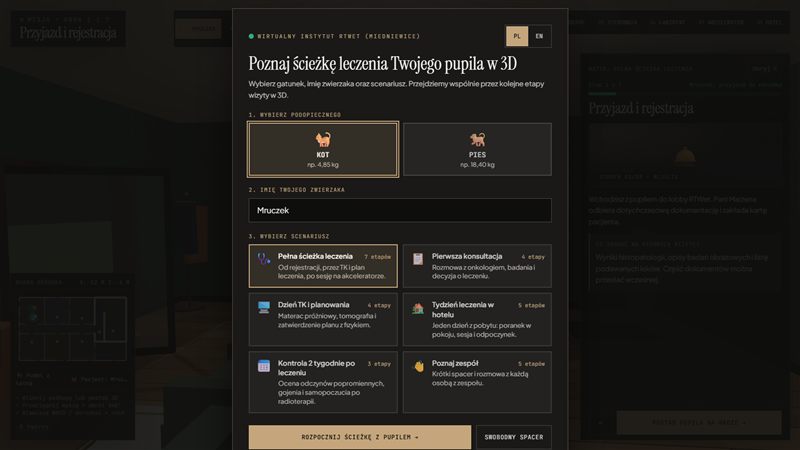
Would you like to see what the centre looks like and how treatment proceeds before you arrive with your pet? Take the virtual tour of the RTWet centre – from registration, through the CT scan, to a session on the accelerator.
Where does radiotherapy take place?
RTWet – Veterinary Radiotherapy Centre
Miedniewice 27C, 96-315 Wiskitki
tel. +48 722 217 211